


Nvidia is 32x more efficient than Huawei.
- Huawei released its new compute clusters and AI chips to great fanfare, but omitted to mention that the reported improvements are almost entirely due to having many more chips it its system than it had before.
- That means that its SuperPod product takes up massive amounts of space in the datacentre, which in turn is likely to make it very expensive to run when considering the amount of compute that it provides.
- Huawei’s SuperPod is a cluster of Ascend AI processors coupled with the networking that allows thousands of processors to function as one single AI computer, much like Nvidia current NVL72 configuration of Blackwell GPUs and Grace GPUs all working together as a single system.
- At Huawei Connect 2025, Huawei laid out its 2-year road map for the Ascend AI processor and its SuperPod cluster (see here).
- First, Ascend: where the 950 variants will be available in 2026 and the 960 variants, which will be available in 2027 and have settled Huawei into a 1 year cadence for AI chip updates.
- These are Huawei’s answer to Nvidia’s Rubin and which will become available along similar timeline.
- The 950 will deliver 2 PetaFLOPS of compute at FP4 while the 960 will deliver 4 PetaFLOPS of FP4 compute.
- This is where the alarm bells start ringing as Nvidia says Rubin is capable of 50 PetaFlops at FP4 per chip, raising immediate questions about Huawei’s efficiency & economics.
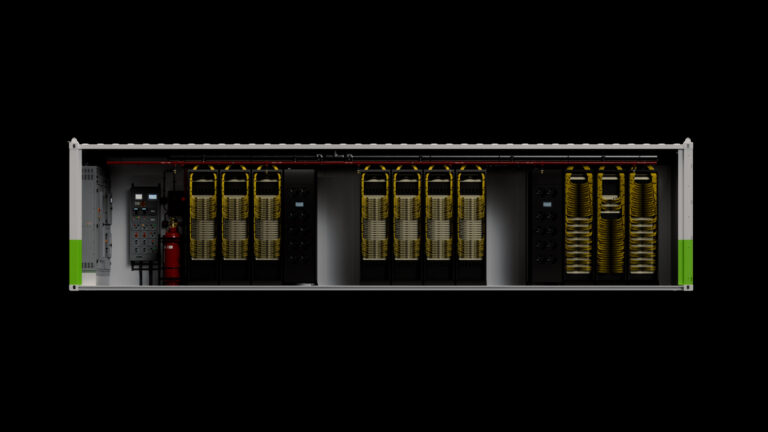
- Second, SuperPod: where the Atlas 950 SuperPod consists of 8,192 Ascend 950DTs housed in 128 compute cabinets and supported by 32 communications cabinets making 160 in total.
- The SuperPod is deployed in 1000m2 of space and will, in total, produce 16 ExaFLOPS of FP4 compute.
- By contrast, Nvidia’s forthcoming NLV144 will produce 3.6 ExaFLOPS at FP4 (8 ExaFLOPS for the CTX variant) and will do so in a single cabinet.
- The average datacentre cabinet measures 800mm by 1200mm meaning that it takes up 0.96m2 of space in a datacentre.
- Huawei’s 1000m2 includes the space needed for aisles, space for cooling and so on, while the 0.96m2 above is just for the cabinet.
- The immediate conclusion is that Nvidia needs 5 cabinets (4.8m2) of NVL144 to produce 18 ExaFLOPS of compute while Huawei needs 160 (153.6m2) to produce 16 ExaFLOPS.
- Hence, the footprint of Nvidia equipment is 32x smaller than Huawei’s for an equivalent amount of compute.
- (Note that the 153.6m2 is just the cabinets, while the 1000m2 includes the aisles and the supporting infrastructure needed for the system to function)
- This supports RFM and Alavan Independent’s long-held view that while China can make cutting-edge algorithms, it cannot do so economically.
- Leaving aside the cost of manufacturing of the chips themselves, where I have long argued Huawei has much higher costs and lower yields than TSMC’s leading edge, the cost of building and running 160 Huawei cabinets compared to 5 from Nvidia or AMD is going to be substantial.
- This is why the Chinese state has no choice but to mandate that Chinese companies use Chinese chips, because it looks to me that they would not choose to do so on their own.
- However, overseas, the Chinese state carries much less influence, and non-affiliated countries will have the ability to choose freely which system they want to buy.
- With the choice of 160 cabinets compared to 5, this is not a very difficult choice to make.
- This is why I continue to think that China will really struggle to compete in overseas markets, as while it can deliver the compute, it can not do so economically.
- This is where Nvidia, AMD and everyone else will make up for what they have lost in China with revenues and market share growth in other countries.
- Hence, I continue to think that the Chinese are behind and that there is very little scope to catch up, given that it has no access to cutting-edge semiconductor manufacturing.
- This will be crucial to the ideological struggle that is being played out between China and the West, and at the moment, I continue to think it is the West that has the advantage.





Blog Comments
TLT
September 20, 2025 at 7:46 am
“Hence, I continue to think that the Chinese are behind and that there is very little scope to catch up”
Before the India Pakistan conflict, the French company Dassault must have had the same idea about its Rafale fighter jet as you did, right?
RICHARD WINDSOR
October 10, 2025 at 11:36 am
OK.. so where is the Huawei 5nm chip you have been promising?