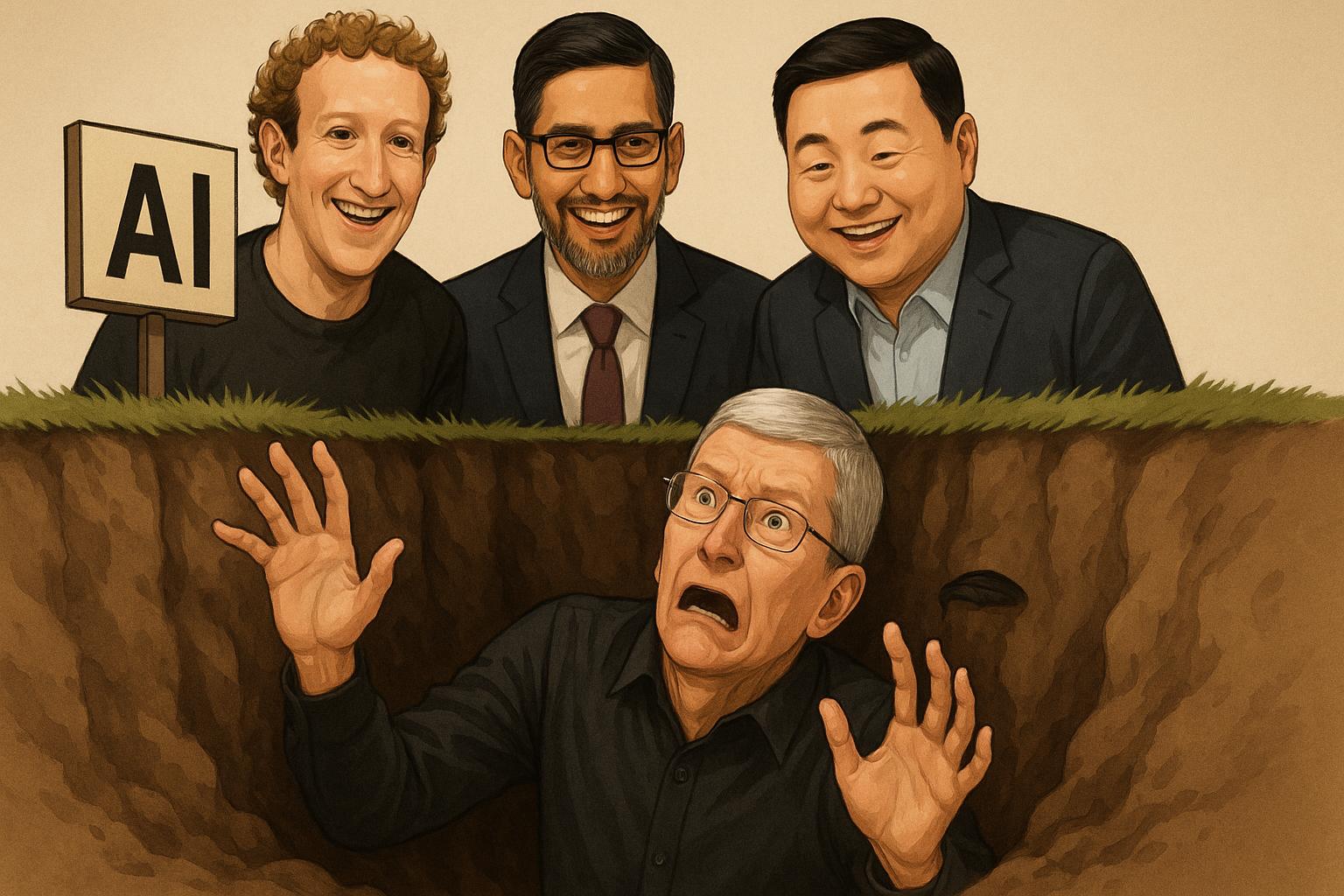
Acquisition is the only way out.
- The best way to fix Apple’s AI problem would be to create an AI product, let the users test it to destruction and use the data to make the product better iteratively, but its reputation for perfection and secrecy means that it can never go down this route.
- This will make it very difficult to create a competitive product, meaning that it is likely to acquire one of the other players when they get into trouble.
- Apple’s latest attempt to fix its AI involves a chat app (much like Gemini, ChatGPT, etc) that runs on the new technology that is being developed to power Siri, which some Apple employees can use to assess the new AI and improve its performance.
- It is going to need access to an LLM of some description, and so I would not be surprised if Apple has taken one of the open-source models from Hugging Face and heavily modified it.
- Apple is hoping to launch the revamped assistant in March 2026 with a full overhaul of the AI experience at the end of 2026.
- However, it is here that I think that Apple is going to fall short as its weakness in AI has everything to do with its corporate culture and very little to do with its ability to hire the right brains.
- When OpenAI, Google, Anthropic and so on have a new product, they know it will not be perfect on launch and expect to iteratively improve it based on user feedback.
- This is the beauty of having the software running entirely in the cloud, as an update is a single button push and the service changes for all users, which means one can continuously improve it with no disruption.
- Apple, on the other hand, never releases anything until it thinks it is perfect, and its culture has not fully absorbed the advantages of how easily and quietly one can update a cloud-based service.
- Furthermore, its obsession with secrecy also means that no one outside of the company gets to test an unreleased product.
- While this might be fine for consumer electronics hardware, this does not work very well for AI, as its ability to behave randomly and badly is much greater than that of regular software, which is why one needs millions of testers all trying to break it.
- Hence, I don’t think this latest attempt is going to produce any real improvement because the tester pool is not nearly as deep and diverse as it needs to be to catch all of the embarrassing errors and misbehaviours that these systems always exhibit when they are new.
- Instead, I continue to think that Apple is going to have to acquire one of the LLM players when it runs out of money and there is no more available.
- This is not the situation we find ourselves in today, and the belief is that the time when machines are more intelligent than humans is just around the corner, and no one can afford to miss it.
- The problem is that there is no empirical sign of this, and as such, there is very likely to be a correction as valuations and investment flows adjust to reality.
- This will hurt all players, but it will hurt the pure play LLM companies (OpenAI, Anthropic Mistral etc) the most as their expectations and their valuations are based on superintelligence soon becoming a reality.
- I have no idea when this correction will set in, and, at the moment, there is no sign of it, but I remain convinced that it will happen.
- It is at this point that the LLM companies will get into trouble, as they have massive compute commitments that are paid for by raising money.
- Hence, when sentiment corrects and the flow of cash dries up, many of these companies are likely to go out of business (including OpenAI).
- It is at this point that Apple can buy one of these companies and bring it in-house to power Siri exclusively.
- The good news for Apple is that, at the moment, there is no sign of AI having any effect on the user purchase decision for smartphones, which means that Apple has time to get its ducks in a row.
- How much time remains to be seen, but I would have thought that Apple has at least a year or two to figure this out.
- Either way, I see very little reason to get involved in the shares, which remain expensive for a company struggling with the latest technology and with no avenue to reignite real growth.
- I would rather own Samsung, which I hold in the form of the London-listed GDRs and remain very happy with it.