

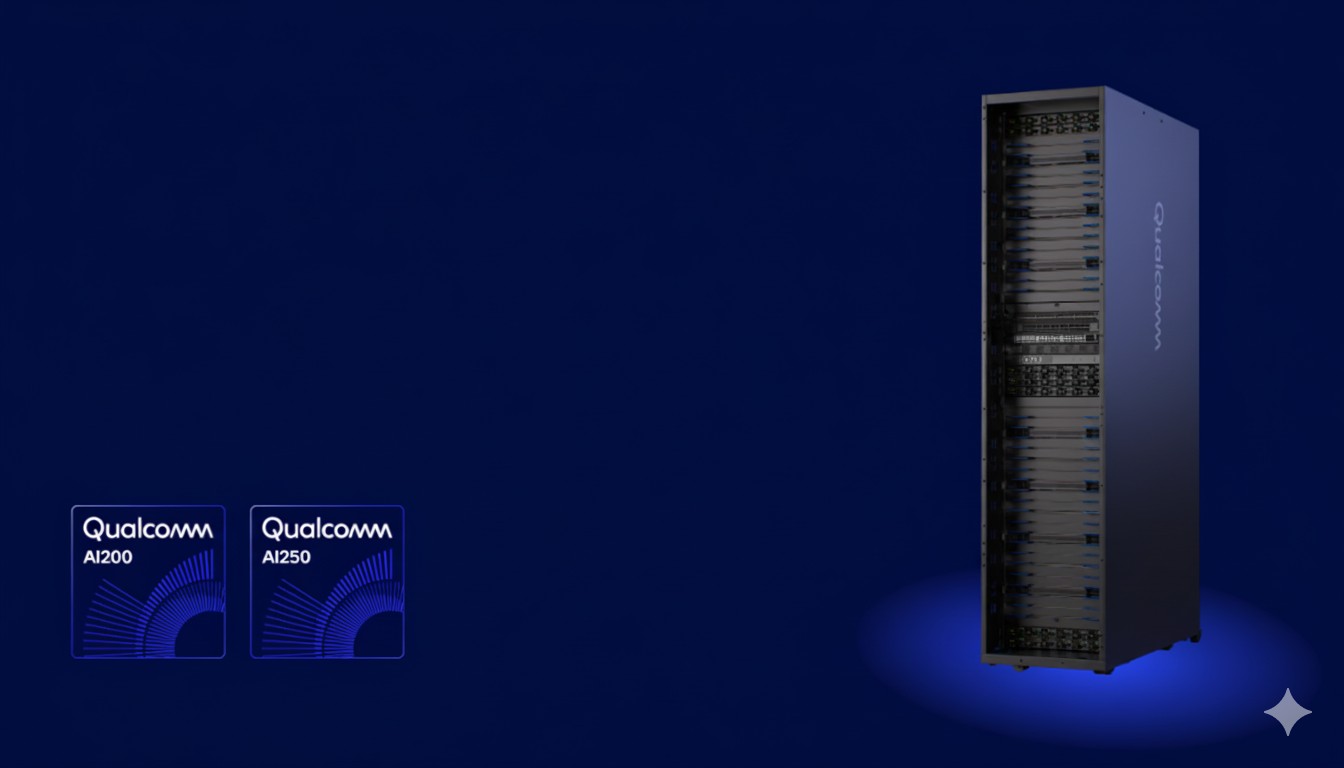
Amazon announces it’s a customer.
- Amazon has announced that it will be a customer for Qualcomm’s data centre business, and although there is an option grant to Amazon, it is not the giveaway that AMD made to OpenAI and Meta.
- At its analyst day in June 2026, Qualcomm announced that it had 4 hyperscalers in the bag, but was only able to announce Meta and Microsoft.
- I suspected at the time (see here) that Amazon was one of the other two, but it now looks like a bit more negotiation was required before the deal was ready, which came to fruition yesterday.
- The main terms of the deal/partnership are as follows:
- First, chips: where Qualcomm will build a custom version of its data centre chip for Amazon, which will be used for running inference workloads.
- Crucially, this is more than just a statement of intention, as Qualcomm will begin recognising revenue from Amazon in Q4 26, which is Qualcomm’s FQ1 27.
- From the details of the warrant grant, it is clear that this could become a very substantial business in its own right (see below).
- Second, optical transport: which is rapidly becoming a bottleneck in the data centre and where Qualcomm has long had expertise from its telecom heritage.
- Amazon and Qualcomm will co-develop solutions which Amazon will use in its data centres, but it is unclear whether Qualcomm can resell these to anyone else.
- Third, AWS usage: which is Qualcomm’s end of the deal, where it will increase its usage of AWS infrastructure for its automated chip design workloads (EDA).
- This is work that Qualcomm was already carrying out, so it does not necessarily represent an increase in costs for the company, but it will represent an increase in spend allocated to AWS and away from somewhere else.
- Fourth, warrants grant: where Qualcomm has granted Amazon 25m warrants with a strike price of $161.26 and a 10-year life.
- The options vest in tranches after certain spending thresholds are met, up to a maximum of $60bn in cumulative revenues for Qualcomm.
- Based on Amazon’s initial firm commitments, 3.75m warrants are vested immediately.
- AMD has entered into similar deals with both OpenAI and Meta, but AMD’s warrants have an exercise price of $0.01 (basically free), while Qualcomm’s warrants are priced at 4% below the last close before the deal was announced.
- This makes a massive difference because Amazon is paying close to a market price for the shares issued by Qualcomm, while AMD is giving them away.
- Hence, it is Amazon that pays for the shares, as shareholders receive the money that Amazon pays to acquire the shares.
- When the strike price is $0.01, it is existing shareholders who pay for the shares through dilution, while OpenAI and Meta are basically getting the chips for free (see here).
- From a shareholder perspective, this is a far superior arrangement as shareholders are being diluted by only 2.4% instead of 20% and they get paid for the shares the company issues.
- The net result is that Qualcomm now has three confirmed hyperscalers (Meta, AWS and Microsoft) as clients, putting to bed any doubts about whether the data centre offering has credibility.
- Furthermore, with the potential for one customer alone to generate $60bn in revenues over a 10-year period ($6bn a year), it is clear that the upside risk greatly outweighs the downside.
- At its analyst day in June, Qualcomm increased its 2029 non-smartphone revenue targets by 82% and said that it could achieve $18 in EPS in 2029.
- I can get to 2029 Adj-EPS of $20 without trying very hard, putting the company on less than 10x 2029 PER.
- Qualcomm is pretty much the only company that has not rallied strongly on the back of the AI opportunity, and at some point the market will realise that there is more here than just smartphone chips.
- I have a significant position in the shares and am looking for $310 before I would begin to consider letting some go.







Leave a Comment