

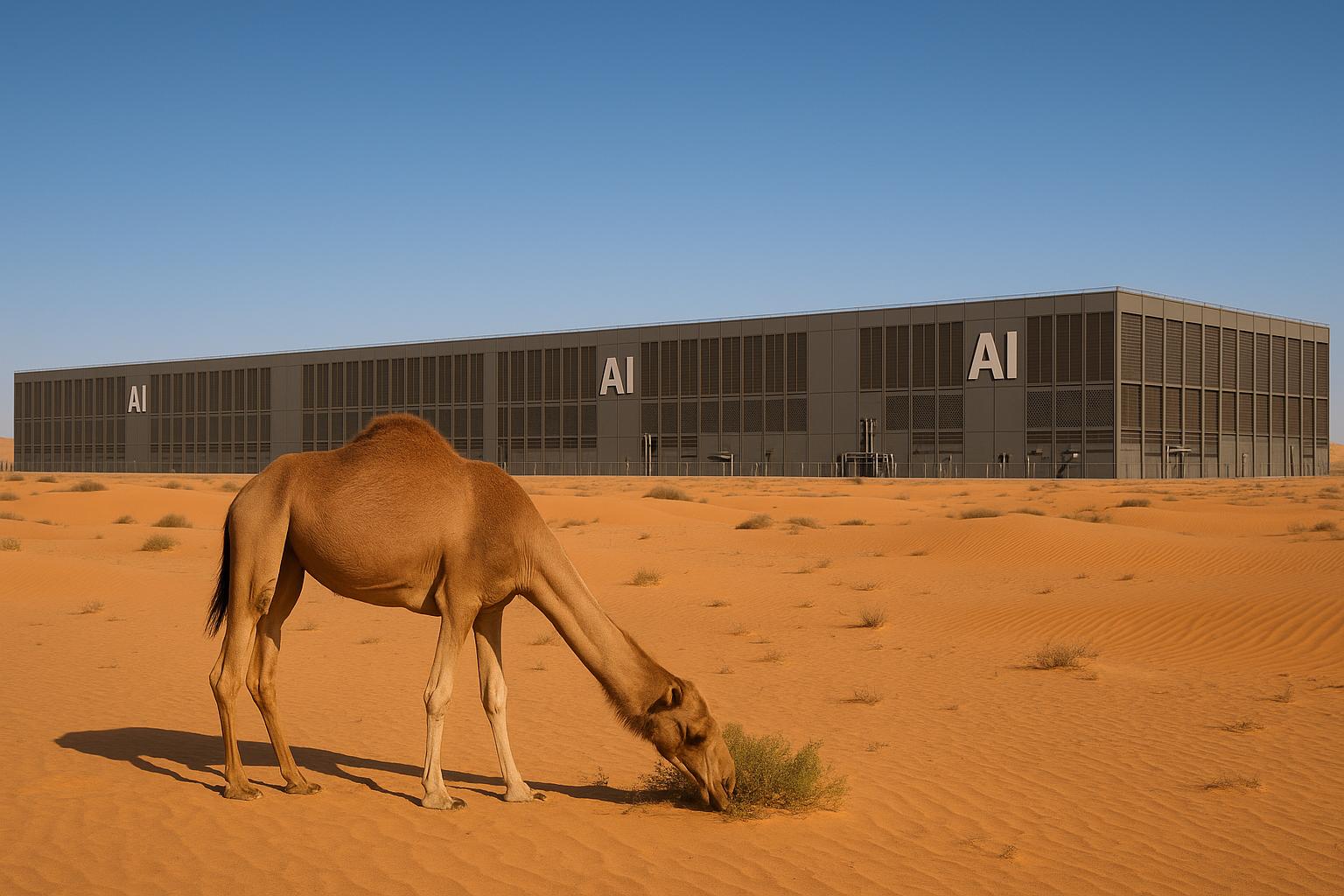
0.5m chips are a drop in the ocean
- To meet its commitments, the Middle East needs to import at least 11m chips, meaning that the initial grant of a license to import 0.5m into the UAE is a drop in the ocean, although it is enough to build about 0.8GW of compute using Grace Blackwell.
- The Middle East story is very simple in that oil-rich countries in the region have abundant space, power and cash as well as a need to diversify their economies away from oil and gas.
- Converting those three commodities into compute and exporting it is a good way to diversify further, and given the abundance of these commodities, they should be able to offer compute very competitively.
- For example, Humain, which is owned by the Public Investment Fund (PIF) of Saudi Arabia, thinks that the combination of these three commodities and the use of Grok LPUs will enable it to offer compute to the market 40% cheaper than anyone else can.
- I suspect that companies intending to build compute in the UAE are thinking along similar lines.
- However, between the two countries, at least 11GW of capacity is planned to be built, but this will necessitate something like 11m GPU chips to be exported to the region, meaning that the current licence for 0.5m chips for the UAE is nothing more than a drop in the ocean.
- Furthermore, it looks like none of the 0.5m chips are destined to be sold to G42, which is the UAE company that is expected to be the one that builds and runs 5GW of compute capacity in Abu Dhabi.
- This alone will necessitate around 5m chips, which, combined with some of my other research, leads me to think that G42 is somewhat behind in the race to build compute in the region.
- Humain has at least broken ground on two sites, which, between them, will eventually house 11 datacentres with 200MW each.
- The region has a tendency to make large plans and then be forced to scale them back, but I think this situation is quite different.
- Neom, for example, while incredible in its vision, does not really do very much to grow the Saudi economy or diversify it away from petrochemicals and the feat of engineering required to pull it off beggars belief.
- It is also very expensive, and so unsurprisingly, a number of the projects under the Neom umbrella have been scaled back to more realistic levels.
- Compute as an export is different, as the engineering required to pull it off is well known, and it will have a direct and beneficial impact on both the Saudi Arabian and the UAE economies.
- Furthermore, at the moment, there is so much demand for compute that Humain claims to have presold a 1GW of capacity already, with the UAE having secured OpenAI as its anchor tenant.
- Therefore, assuming that the AI bubble does not pop, only the ability to source the silicon and the equipment to support it is likely to hold these countries up.
- However, sourcing the silicon is going to be difficult as not all people in Washington are convinced that the region has fully pivoted away from China, although RFM Research indicates that this is a rational move for these countries to make.
- This is because RFM Research has concluded that while China can create leading-edge technology, it is unable to do so competitively, meaning that Western technology is now far more competitive on price than it was 5 or 6 years ago.
- For example, Huawei will need to use 160 cabinets to produce the same amount of compute that Nvidia can with 5 (see here), meaning without heavy state subsidy, Huawei is not a rational choice for anyone who can also buy Nvidia or AMD.
- Hence, I think the region’s pivot away from China and towards the West is genuine and that licenses to buy the remaining 10.5m chips will be forthcoming over the coming months and years.
- However, at the moment, it is one thing to get a license, and it is quite another to be able to source the chips, as everyone is clamouring to buy, and supply remains constrained.
- For example, I think that Micron is already sold out of HBM memory, leading me to conclude that if one were to telephone Jensen with a buy order, one is unlikely to get filled much before 2027.
- Availability at AMD is probably better, but with the 6m chip order that OpenAI has also placed, I suspect wait times are also substantially on the rise.
- The net result is that I suspect that the Middle East build-out is going to take much longer than expected, but in my mind, this is not a particularly big problem.
- Demand for oil is not collapsing as many forecast, and in fact, I think it could easily continue to rise for many years to come, meaning that the outlook for the Middle East economies remains pretty secure.
- Hence, if the rollout takes 5 years longer than anticipated, this is not a particular problem and would give the region more time to ensure that the other infrastructure that this will need is in place when the data centres are ready to be turned on.
- This leads me to remain pretty positive on the outlook for this new industry in the Middle East and to expect that it will become a significant provider of compute, in the same way that it is a significant provider of energy today.





AI Newsround – Broadcom &a ...
05 March 2026